Asylum Process vs Student Visa: Complete Comparison Guide for Nepali Applicants
Looking for a legal path to France? Many Nepalis weigh the asylum route against student visas, business visas, and tourist visas. This comprehensive guide breaks down the real benefits, risks, and long-term consequences of each option so you can make an informed decision.
Why Do So Many Nepalis Choose the Asylum Route in France?
Here’s something that rarely gets discussed openly: why do large numbers of Nepalis — students, tourists, and even working professionals — end up choosing the asylum process in countries like France instead of conventional visa channels?
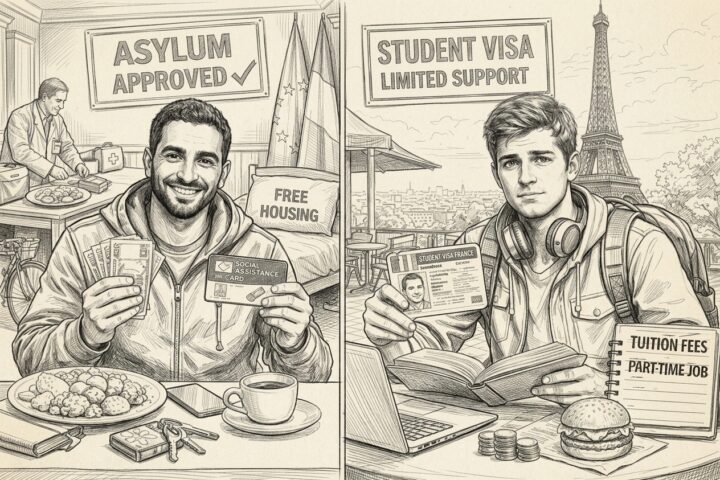
It’s not always desperation. In many cases, the asylum system simply looks like a smarter deal on paper. Compared to a student visa or business visa, asylum appears to offer more support with fewer upfront requirements. No university admission letter. No large bank balance proof. No expensive tuition fees. You arrive, apply on the basis of protection or persecution, and the state provides housing support and a monthly allowance while your case is processed.
You can see why this is attractive — especially if you are young, financially constrained, and trying to build a future abroad. But the full picture is far more complicated. Treating asylum as a “visa hack” can destroy careers, families, and future opportunities.
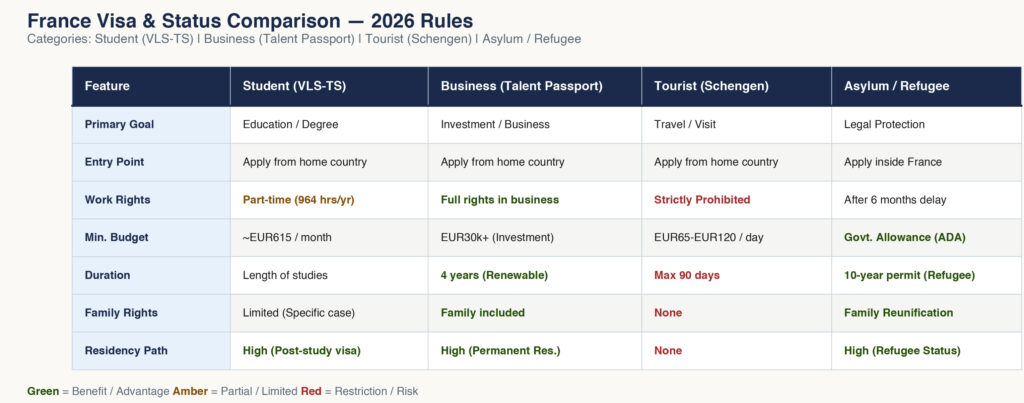
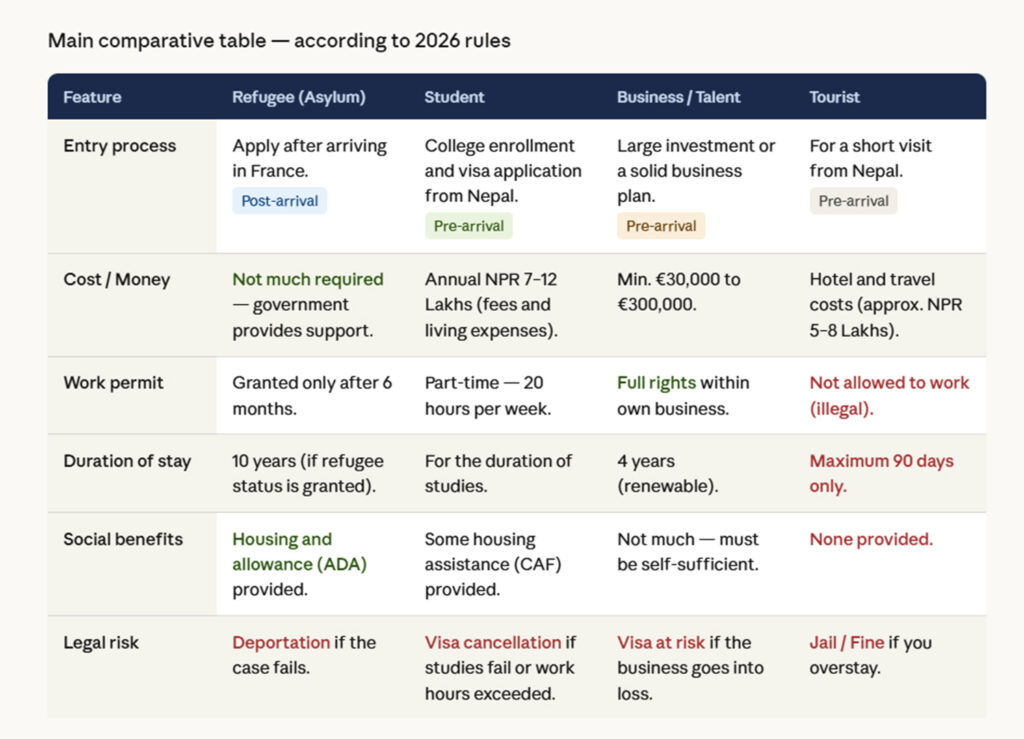
Visa Options for Nepalis in France: Side-by-Side Comparison
1. Refugee / Asylum Route — High Reward, Higher Risk
What works in your favor:
- Once you apply in France, the government can provide accommodation and a monthly stipend called ADA (Allocation pour demandeur d’asile) — a daily allowance for basic living costs.
- You do not need university enrollment, academic transcripts, or proof of funds to start the asylum process.
- If your claim is approved, you gain rights close to those of a French citizen: the right to work freely, access healthcare, family reunification, and a pathway to citizenship.
- Healthcare and basic social support remain available during the processing period.
What can go wrong — and badly:
- The process often takes 1 to 2 years (sometimes longer). That is a long period of uncertainty.
- If your case is judged fraudulent or unfounded, you risk deportation. This is not a minor administrative issue — it can permanently close doors to legal entry in many countries.
- Permission to work during the asylum process is restricted and depends on the stage of your application. It is not automatic.
Bottom line: The asylum path is not a shortcut. It is a high-stakes legal process designed for people facing genuine persecution.
2. Student Visa — The Secure and Dignified Path
Advantages:
- This remains the most respected and stable legal route into France for young Nepalis.
- After completing your studies, you can obtain a 1-year job-search permit (APS – Autorisation Provisoire de Séjour) that makes the transition to a work permit much easier.
- You build real credentials, a professional network, and a clear long-term trajectory.
Challenges:
- You need a confirmed university or college admission letter. Without it, there is no student visa.
- You must prove sufficient bank balance, ability to pay tuition, and present a clear study plan.
- Tuition fees, accommodation, and living costs in France add up quickly.
- You are limited to part-time work (usually 964 hours per year). Studying is the priority.
- Many social benefits available to permanent residents are not accessible to students.
Key insight: The student visa demands more money and effort upfront, but it builds something asylum seekers often later envy — legitimate status with a clear future path.
3. Business / Investor Visa (Talent Passport) — For Those With Capital
France’s Talent Passport can grant a 4-year residency card if you have money or a strong startup idea. Family members can usually join you. Requirements include:
- Small business / company creation: Minimum investment around €30,000
- Larger investment projects: Up to €300,000 or more depending on the category
- A solid business plan, financial documentation, and patience for detailed administrative procedures
This route is elegant and direct — but it is not realistic for most young Nepalis.
4. Tourist Visa — The Tempting but Dangerous Trap
A tourist visa is fast and relatively easy to obtain. Unfortunately, it is frequently misused. Many Nepalis enter France on a short-stay visa and simply overstay.
Overstaying is completely illegal. The consequences follow you for years. If you later try to regularize your status through marriage, a work permit, or any other legal channel, your previous overstay becomes a major obstacle. You also live under constant risk of police checks and removal.
It is simply not worth the long-term damage.
What Refugee Status in France Actually Means
If you successfully complete the asylum process, the rights you receive depend on the exact form of protection granted. Here is a clear breakdown.
Category 1: Full Refugee Status (Statut de Réfugié)
This is the highest level of protection, based on the 1951 Geneva Convention.
Card issued: Carte de résident — a 10-year renewable residency card
Key rights and benefits:
- Residency: 10-year resident card, fully renewable — stable long-term status
- Work rights: You can work in almost any sector (except certain public roles reserved for French citizens)
- Travel document: You receive a “Blue Card” (Titre de Voyage). Important restriction: you cannot return to your country of origin
- Social security: Full access to social security, health insurance, and unemployment benefits (when eligible) — same as French citizens
- Family reunification: You can apply to bring your spouse and children under 18
- Citizenship path: After 5 years as a refugee, you can apply for French naturalization
- Education: Children can enroll in school without barriers
Category 2: Subsidiary Protection (Protection Subsidiaire)
Granted when you do not fully meet refugee criteria but still face serious danger (risk of death, torture, or armed conflict).
Card issued: Carte de séjour pluriannuelle — a 4-year card, with the possibility to upgrade to a 10-year card later
Key rights:
- Residency: Multi-year permit (usually 4 years) with a clear path to longer status
- Work rights: Full authorization to work in France
- Travel document: France can issue a travel identity document (Titre d’identité et de voyage) if you cannot obtain a passport from your home country
- Social benefits: Healthcare (PUMa), housing assistance (APL), and other support — broadly similar to full refugee status
Category 3: Temporary Protection (Protection Temporaire)
An emergency measure usually activated during large-scale displacement (for example, the Ukrainian crisis).
Card issued: Autorisation provisoire de séjour (APS) — valid for 6 months, renewable up to a total of around 3 years
Key points:
- Duration is short and dependent on the ongoing situation
- You can usually start working immediately
- Access to daily allowance (ADA), healthcare, and temporary housing support
- This status is not typically available to individual Nepali applicants outside a mass-displacement context
Benefits Available Across Most Protection Statuses
Regardless of the exact protection category, the following usually apply:
- Education for children: Free and compulsory under 18. University students may apply for CROUS scholarships on the same basis as French students.
- French language classes: OFII (Office Français de l’Immigration et de l’Intégration) offers free French language courses — one of the most useful integration tools.
- Housing assistance (CAF): Eligible renters can receive monthly housing aid (APL) to help with rent.
The Bottom Line: Choose With Your Eyes Open
The asylum path can look highly attractive — and for people facing genuine persecution or serious danger, it is the correct and necessary route. France’s asylum system exists for that purpose.
However, using asylum as a convenient alternative to a student visa or work visa is extremely risky. The system is thorough. False or weakly founded claims can lead to rejection, deportation, and long-term barriers to legal entry elsewhere.
The student visa is harder and more expensive at the beginning. It demands admission, funds, and commitment. But it builds a sustainable, respected foundation. The business/investor route requires real capital. The tourist visa is temporary for a reason — overstaying creates lasting problems.
Know your options. Understand the trade-offs. And if you decide to take a major step, do it with full awareness of the consequences.
Hashtags
#AsylumInFrance #RefugeeStatusFrance #StudentVisaFrance #NepaliInFrance #FranceVisaGuide #ImmigrationFrance #TalentPassport #StudyInFrance #NepaliStudentsAbroad #VisaComparison #RefugeeCardFrance #ADAAllowance #FrenchResidency #SchengenVisaRisks #LegalImmigration #NepalToFrance #WorkInFrance #FamilyReunification #OFIIFrance #LifeInFrance #AsylumVsStudentVisa #FranceImmigration2024 #NepaliDiaspora #ProtectYourFuture
Disclaimer
This article is for informational purposes only and does not constitute legal advice. Immigration rules change. Always verify current requirements with official French government sources (OFII, French consulate, or a qualified immigration lawyer) before making any decisions.