
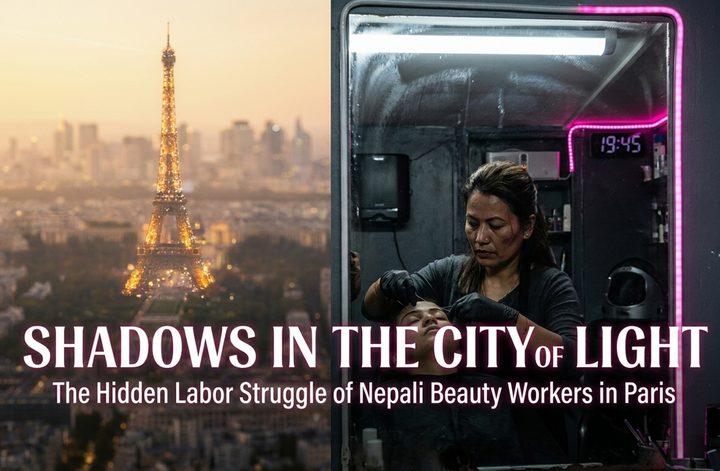
Behind the Glitter of Paris Beauty Salons
Every year, millions of tourists photograph the Eiffel Tower bathed in golden light. They stroll the grand boulevards, sip coffee on sun-drenched terraces, and leave with postcard images of the City of Light. Yet just a few streets away, in the narrow back-alleys of the 10th, 18th, and 19th arrondissements, a very different Paris operates in silence.
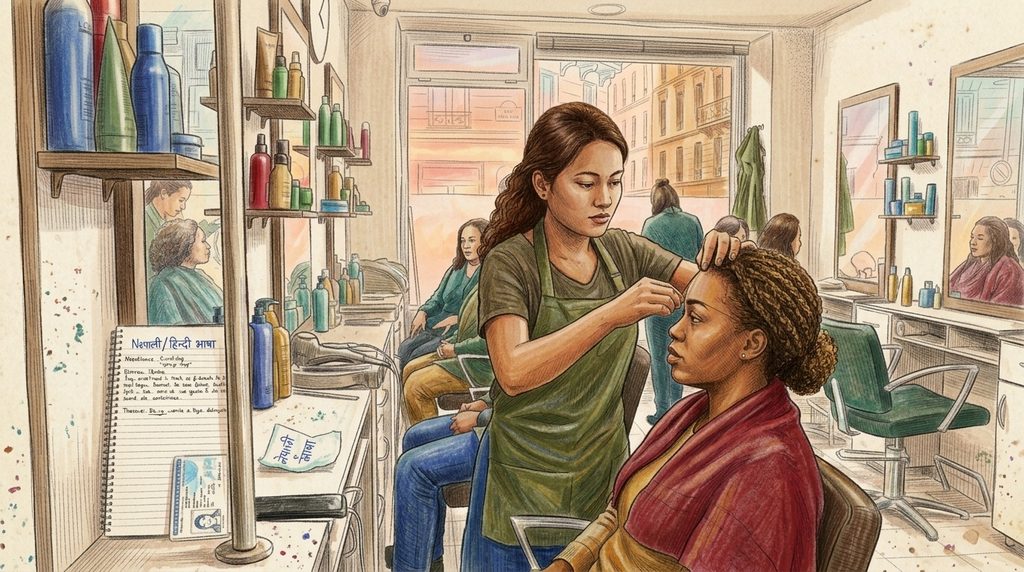
Here, tucked between convenience stores and phone repair shops, small beauty parlours line the streets — many owned by Indian, Pakistani, or Nepali entrepreneurs. Braiding, threading, waxing, facials. The signs may be in Hindi, Nepali, or simply a photo of perfect eyebrows. Inside these cramped salons, young
Nepali women work long, invisible hours. They have no contracts, no pay slips, no health coverage, and often — no legal right to work at all.
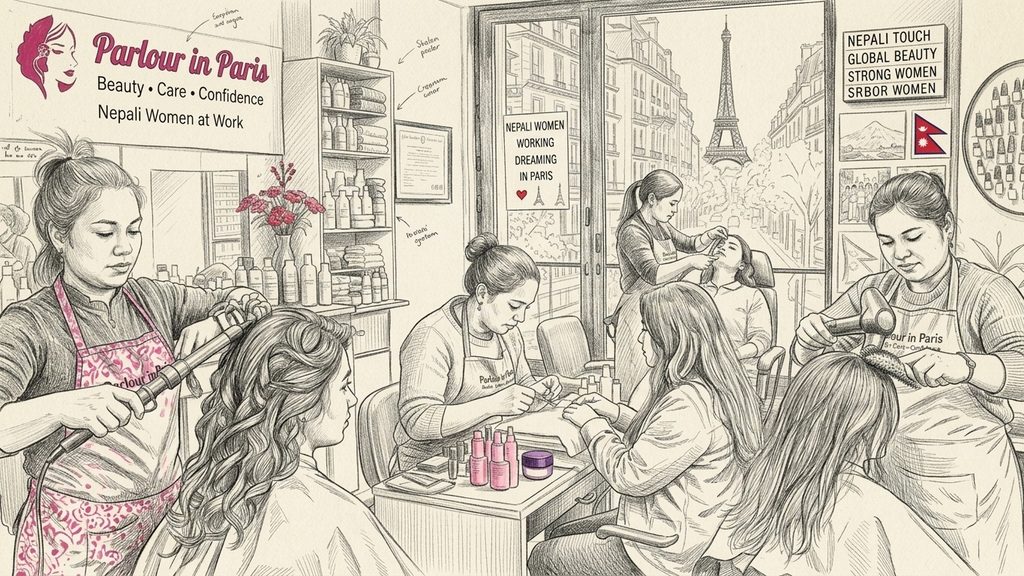
This is the story of Paris’s shadow beauty industry — a hidden world of illegal labour, crushed dreams, and systematic exploitation of asylum seekers. And it is a story that urgently needs to be told.
The Six-Month Trap: How French Asylum Law Creates Vulnerability
Under French law, anyone who submits an asylum application must wait a minimum of six months before they are legally permitted to work. The official rationale is procedural: give the authorities time to assess the claim before the person enters the labour market. In theory, it is a safeguard. In practice, for desperate young women who arrive in France carrying debt, hope, and almost nothing else, it becomes a six-month window of profound vulnerability.
Most Nepali women seeking asylum in France have borrowed significant sums — sometimes equal to several years of a family’s income — to pay brokers, travel agents, and middlemen for the journey. That debt does not pause while the French immigration authority (OFPRA) reviews their file. Rent does not pause. Hunger does not pause.
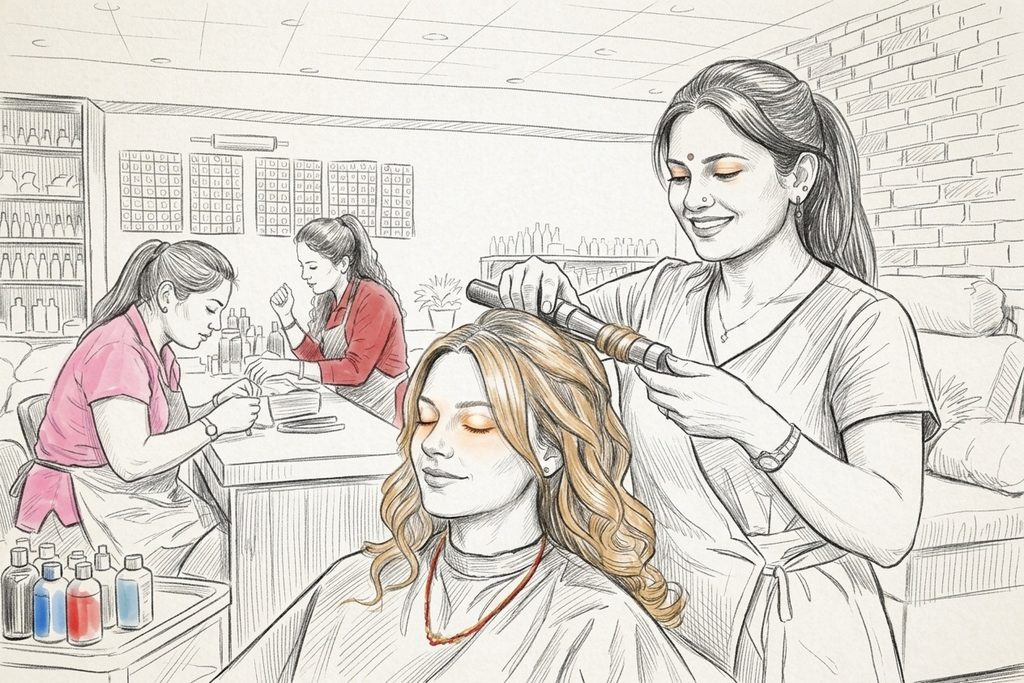
“The first six months were the hardest. I couldn’t work legally, but I had to survive. When the parlour owner said ‘just help out, learn the job,’ I said yes. I didn’t know what else to do.”
This is the exact moment exploitation begins. And the people waiting to take advantage of it are already in place.
From ‘Volunteer’ to Victim: How Labor Exploitation Works in Paris Salons
The process is almost always the same. A newly arrived woman, fresh from her asylum interview at OFPRA, is introduced through a community contact to a parlour owner — usually South Asian, often Nepali or Indian — who offers to “let her learn the trade.” There is no contract. There is no salary discussion. It is framed as an opportunity, even a favour.
Within days she is threading eyebrows, waxing legs, and doing hair — ten, eleven, twelve hours a day. Weeks pass. Then comes the first payment: not a wage, but a gesture. Cash in hand. No paperwork.
The Hard Numbers Behind the Exploitation
Here is the mathematical reality of this underground system:
- Legal minimum wage (SMIC): approximately €1,700–€1,800 per month before tax. These women typically earn only €800–€900 — roughly half.
- Broker commissions: €200–€400 is often deducted by “placement agents” for having “found them the job.”
- Working hours: French law limits the working week to 35 hours. These women routinely work 10am to 9pm, six days a week — nearly 60 hours.
- No protections: No social contributions, no health insurance, no pension, no sick leave. If injured, there is no recourse.
After commissions, some women earn less than €4 an hour — in one of the world’s most expensive cities, in a country that prides itself on some of Europe’s strongest labour protections.
The First Lesson: How to Fool Immigration Inspectors
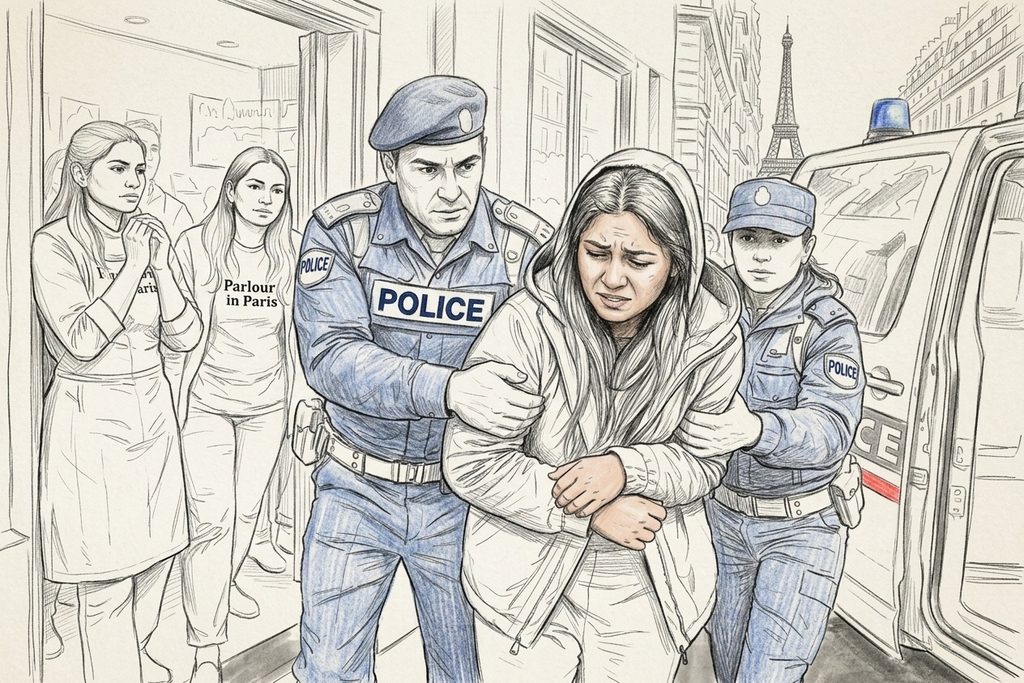
New arrivals quickly learn that two skills are essential: how to perform beauty treatments, and how to avoid the Police aux Frontières (PAF) and labour inspectors from the Inspection du Travail.
The instruction is simple and immediate: if you see police or inspectors approaching, put down your tools, sit in front of a mirror, and pretend to be a customer. Practise looking relaxed. Do not make eye contact. Do not speak unless necessary.
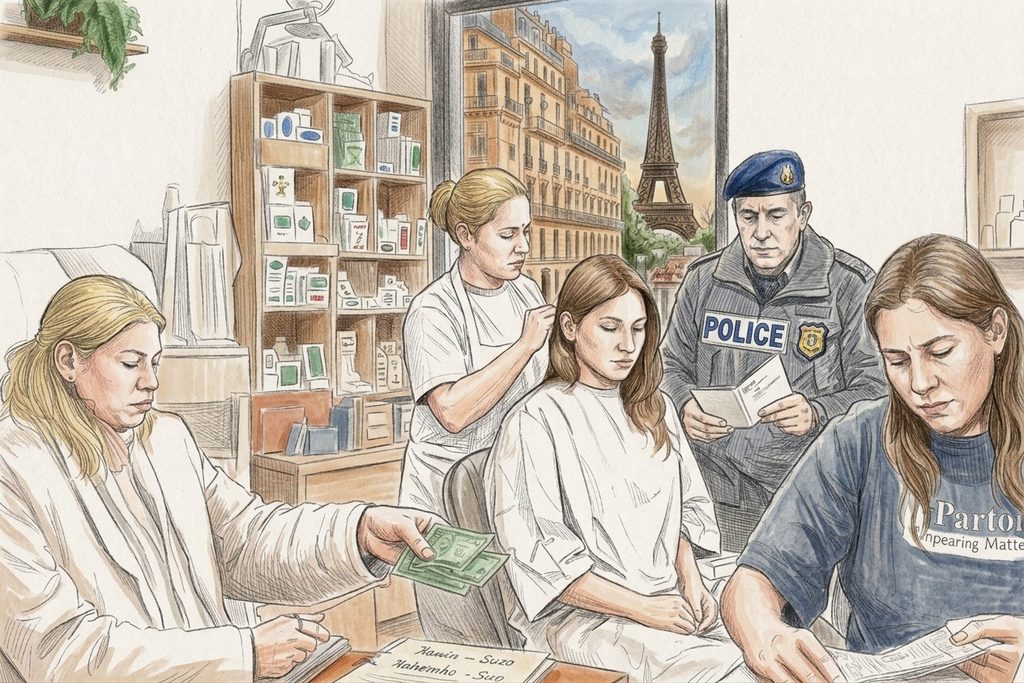
“The first thing they taught me wasn’t how to thread eyebrows. It was how to sit like a customer if the police came in.”
This detail reveals how deeply the informal system is structured around evasion — and how the women themselves are trained as accessories to their own exploitation. If caught working illegally during the six-month prohibition period or later without proper authorisation, they risk an OQTF (Obligation de Quitter le Territoire Français) — a formal order to leave France. Years of struggle, debt, and sacrifice can be erased with a single administrative stamp.
The Five-Year Promise: Hope Used as a Leash
Perhaps the cruellest mechanism is one that is technically legal. Under the French provision known as Admission Exceptionnelle au Séjour, a foreign national who has lived and worked in France for five years and can produce documented proof of employment may apply for a residence permit. It is a genuine pathway to regularisation — but it requires the signature of an employer.
Some parlour owners have weaponised this clause with remarkable cynicism. The promise is offered like this: “Stay with me for five years. Work hard. I’ll sign your paperwork when the time comes.” It sounds like salvation. In reality, it creates a five-year period of enforced dependency.
The woman cannot leave, cannot complain, cannot seek better work — because the employer holds the key to her legal future. She continues working below minimum wage, for illegal hours, without protections, because the alternative is to restart the clock from zero.
“He kept saying: five years and I’ll fix your papers. So I stayed. What was I supposed to do? Go back?”
For those whose asylum claims have already been rejected, the situation is even more precarious. Without a pending application, without refugee status, and without a work permit, they exist in a legal grey zone where any interaction with authorities can end in deportation. They are, in the most literal sense, infinitely exploitable.
What French Law Actually Says About Undeclared Work
French law is unambiguous. Travail Dissimulé (concealed or undeclared labour) is a serious criminal offence. The penalties are significant:
- Employers found guilty of hiring undocumented workers face up to 3 years in prison and fines of up to €45,000 per worker.
- If the business is incorporated as a company, the fine can exceed €200,000.
- The Inspection du Travail can order the immediate administrative closure of a business for up to three months.
- Workers caught in illegal employment during the six-month prohibition period risk an OQTF — a deportation order — regardless of the circumstances that led them there.
The law therefore penalises both the employer and the worker. Paradoxically, the worker remains the more vulnerable party. The employer can pay a fine and reopen. The worker can lose everything.
The Transnational Network: From Nepal to Paris Back-Alleys
None of this happens spontaneously. A chain beginning in Nepal and ending in a Parisian back-alley makes the system both possible and profitable.
In Nepal, brokers advertise the journey to France as a pathway to a stable future in Europe. They charge fees ranging from a few hundred thousand rupees to several million — sometimes forcing families to sell land or take high-interest loans. They promise a smooth process, contacts on arrival, and arranged accommodation. What they actually deliver is a woman alone in a foreign city, in debt, with no legal status and no safety net.
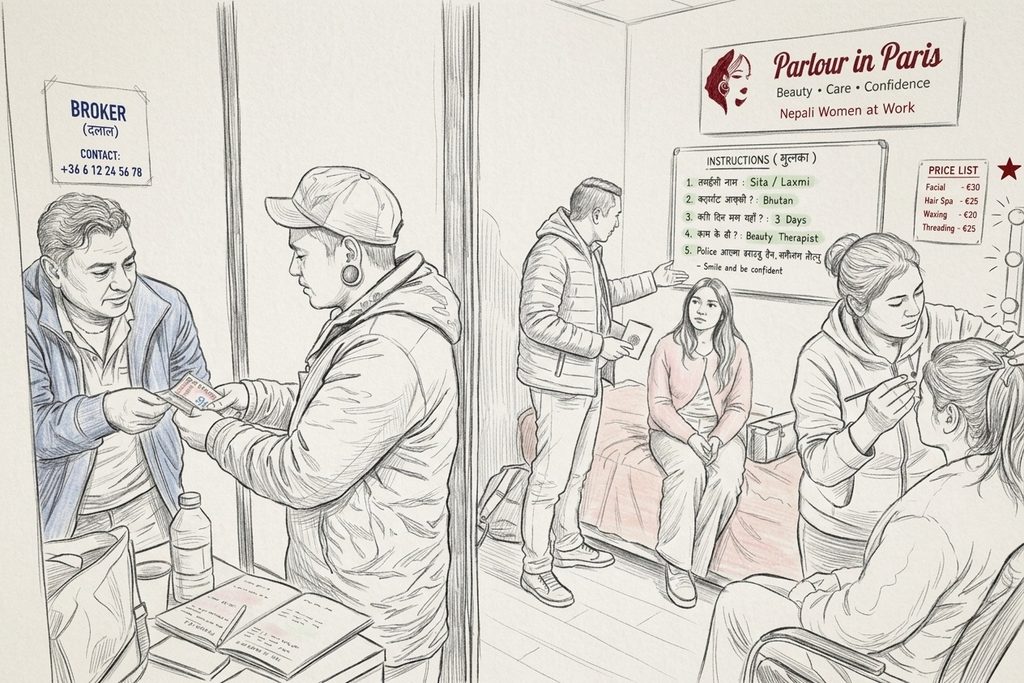
In Paris, a parallel network of “placement agents” — many of them community members who have navigated the system before — connects new arrivals with parlour owners willing to employ them informally. The agent takes a cut. The owner gets cheap, desperate labour. The woman gets a roof and just enough money to stay alive.
It is a supply chain of exploitation that has operated quietly for years — largely invisible to French authorities and completely invisible to the tourists who walk through its shadow every day.
A Way Out: Free Legal Resources for Undocumented Workers in France
The situation is not without recourse — but accessing help requires knowledge that most of these women simply do not have. Several organisations offer free legal support:
- CIMADE (Comité Inter-Mouvements Auprès Des Évacués) — one of France’s oldest refugee rights organisations, offering free legal advice to undocumented migrants and asylum seekers.
- GISTI (Groupe d’information et de Soutien des Immigrés) — a legal advocacy group specialising in immigration and labour rights.
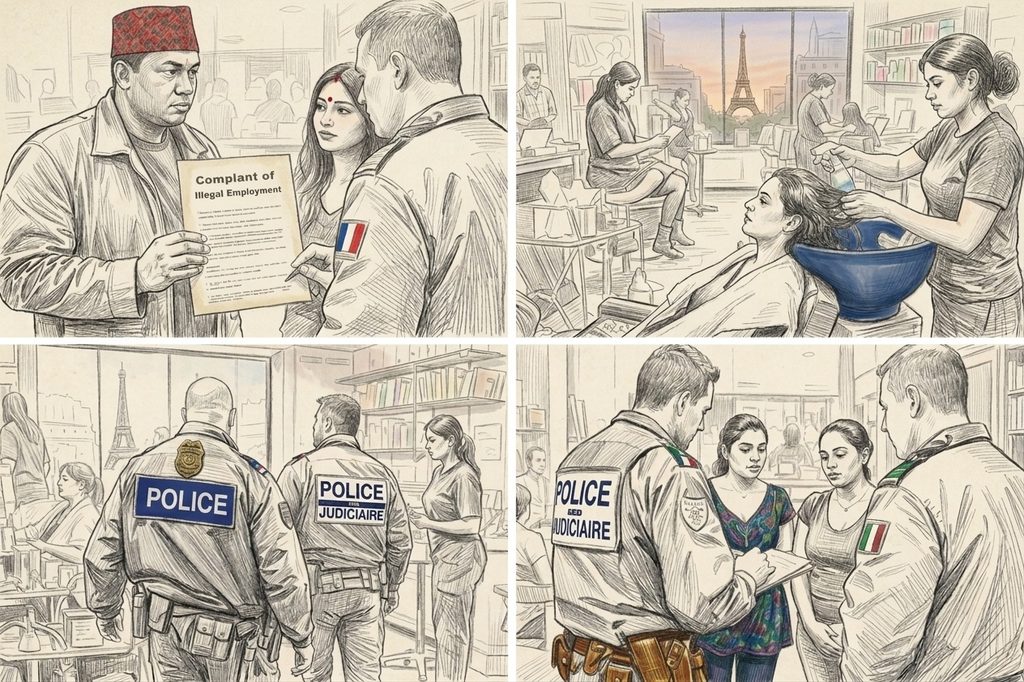
- Inspection du Travail — the French labour inspectorate. Anyone can report labour violations, including illegal working conditions, anonymously.
- URSSAF — France’s social security collection agency, which investigates undeclared labour and accepts anonymous tip-offs.
Critical point: The absence of legal status does not eliminate basic labour rights in France. An undocumented worker who has been illegally employed is still entitled to back wages, compensation, and protection from immediate deportation while a labour claim is pending. Employers depend on workers not knowing this.
Who Is Responsible? Looking Beyond the Salon Owners
It would be easy to assign blame solely to the parlour owners — and their exploitation is real, deliberate, and in many cases criminal. But the system that enables it involves multiple actors.
- The brokers in Nepal who sell false promises and extract impossible fees bear significant responsibility.
- The French asylum system that creates a six-month legal vacuum with inadequate income support leaves women with almost no safe options.
- A political environment in which legitimate worker visa pathways for countries like Nepal remain politically unpalatable sustains the demand for illegal routes.
- And, more quietly, the customers who never ask why that threading costs only four euros and why the woman performing it looks exhausted at noon on a Tuesday.
“They see us every week. They know something isn’t right. But no one asks.”
Conclusion: An Unfinished Story That Demands Light
Paris’s beauty parlours have given many Nepali women a temporary shelter — a place to survive while their legal future remains uncertain. But survival is not a solution. The debt remains. The hours remain. The fear of a knock at the door remains.
Until safe, legal, and accessible pathways exist for economic migration from Nepal to France — proper worker visas, regulated recruitment, and enforceable contracts — the alleyways of Paris will continue to fill with women who came looking for a future and found themselves trapped in someone else’s profit margin.
Their stories are not exceptional. They are the predictable result of a system designed, consciously or not, to keep certain people permanently in the shadows. The least we can do is turn on the light.
What You Can Do If You Suspect Labour Exploitation
If you suspect labour exploitation in a Paris salon, report it to the Inspection du Travail or URSSAF with the name and address of the business. Reports can be made anonymously. You may be the reason someone recovers unpaid wages — or avoids deportation.
Source & Further Reading
Primary reference: behanbox.com — ‘With or Without Papers: Indian Beauty Workers Find Work Freedom in Paris’ (June 2024)
Hashtags
#LaborExploitation #MigrantWorkers #UndocumentedWorkers #AsylumSeekers #HumanRights #Paris #France #Nepal #NepaliWomen #BeautyIndustry #ShadowEconomy #TravailDissimulé #OFPRA #OQTF #InspectionDuTravail #WorkerRights #ModernSlavery #LaborRights #MigrationCrisis #ParisBeautySalons #EndExploitation #SupportMigrants #EthicalBeauty #KnowYourRights #RefugeeRights #WomenRights #SocialJustice #FairWork #NoMoreShadowWork #ParisLife #10eme #18eme #19eme #NepaliInParis #SouthAsianInFrance #CityOfLight #HiddenParis
Note: Images in related coverage are often AI-generated for illustrative purposes only. This article is an original SEO-optimized rewrite for blog use.