
Introduction: The Question Nobody Wants to Answer
Every few months, the same debate resurfaces in the French parliament, in newspapers, and across social media: why can’t France stop fake asylum seekers? The stock answers are always the same — bureaucratic complexity, legal obligations, overloaded courts. But underneath these explanations sits a far messier reality: structural loopholes, organised criminal networks, and possibly an unspoken economic convenience that keeps the system exactly as porous as it is.
This article breaks down why fraudulent asylum claims keep growing in France and across Europe, with a specific focus on the Nepali networks that have turned the asylum process into a business model.
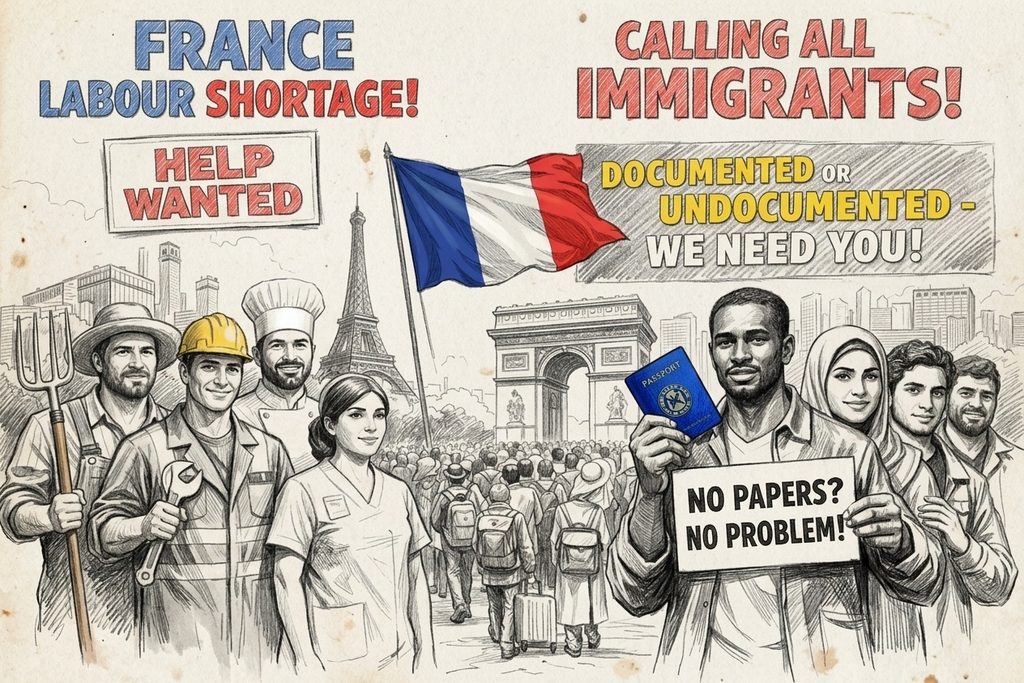
The Legal Architecture That Ties France’s Hands
France’s asylum system doesn’t operate in isolation — it runs under the 1951 Refugee Convention and EU asylum directives, both of which demand that every single application be assessed individually, no matter how implausible it looks on paper.
OFPRA (Office Français de Protection des Réfugiés et Apatrides), France’s asylum authority, cannot summarily reject any claim. It must interview the applicant, examine their story, review supporting evidence, and issue a written decision. Rejected applicants can appeal to the CNDA (Cour Nationale du Droit d’Asile), a process that can stretch the timeline by months or years.
Interestingly, while France has committed roughly €109 billion to AI infrastructure investment — positioning itself as a global leader in computing and quantum technology — its asylum screening process still relies almost entirely on manual review and human interviews, not automated verification.

“The thumbnail of the podcast featuring the President of France on the Raj Shamani Podcast.”
This dysfunction has become political fuel. Marine Le Pen’s Rassemblement National (RN) has built much of its platform around the argument that uncontrolled immigration threatens French identity, strains welfare systems, and undermines wages and housing. Whether or not one agrees with RN’s proposed fixes, the underlying diagnosis — a dysfunctional system — is hard to dispute.

Key legal constraints:
- Every application receives an individual interview and assessment — blanket rejections are not legally permitted.
- Rejected applicants have an automatic right of appeal, which courts are legally bound to hear.
- Even when evidence is weak, deportation can be challenged on humanitarian grounds.
- International privacy rules limit how much France can cross-verify documents directly with origin countries.
None of this makes France naive — it makes France legally constrained. And sophisticated fraud networks know precisely how to exploit those constraints.
The Verification Gap: Why Nepali Documents Slip Through
When a Nepali national applies for asylum in France, the story usually follows a familiar pattern: political persecution, threats from rival parties, harassment by police, attacks from criminal groups. These narratives are often unverifiable — and that unverifiability is exactly the loophole being exploited.
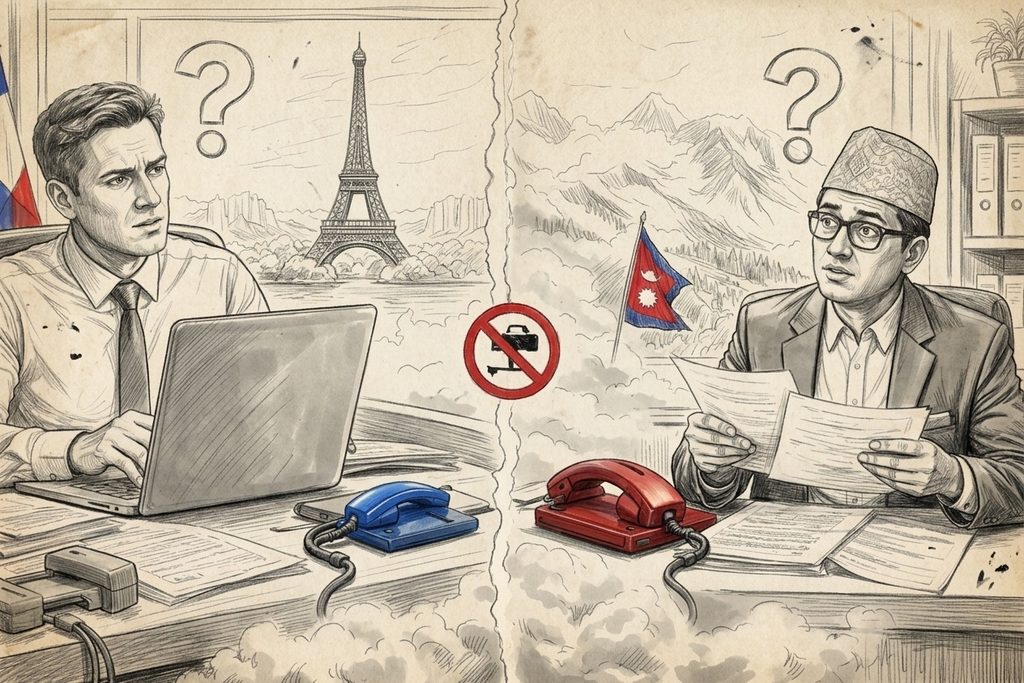
“There is no digital verification system between Nepal’s local authorities and French immigration officials.”
Nepal’s local administrative bodies — ward offices, municipalities — have no digital verification link with French immigration authorities. Police reports, court decisions, and hospital records are frequently paper-based, hand-stamped, and written in Nepali script, making forgeries difficult for French officers to detect unless they have specialised country expertise.
Why fake documents pass review:
- No real-time digital bridge exists between Nepali local governments and French immigration databases.
- Many Nepali local records remain entirely offline, making verification slow and unreliable.
- French asylum officers often lack detailed knowledge of Nepali administrative formats, seals, and signatures.
- Translated narratives can be subtly exaggerated with dramatic details that are difficult to disprove.
- The French Embassy in Nepal does not routinely cross-check documents with the Nepali government, citing international confidentiality norms.
The outcome: an applicant who has done their homework — often with help from a network of ‘coaches’ — can usually pass the initial review without difficulty.
Organised Networks: The ‘Coaching’ Industry
This is arguably the most disturbing part of the story. In France — and increasingly visible on platforms like TikTok — a sophisticated coaching industry has emerged around asylum fraud.
Nepalis who have already secured refugee status or residency coach newcomers on how to succeed: which documents are required, what narrative is most convincing, how to handle difficult interview questions, and — crucially — how to erase digital footprints before applying.
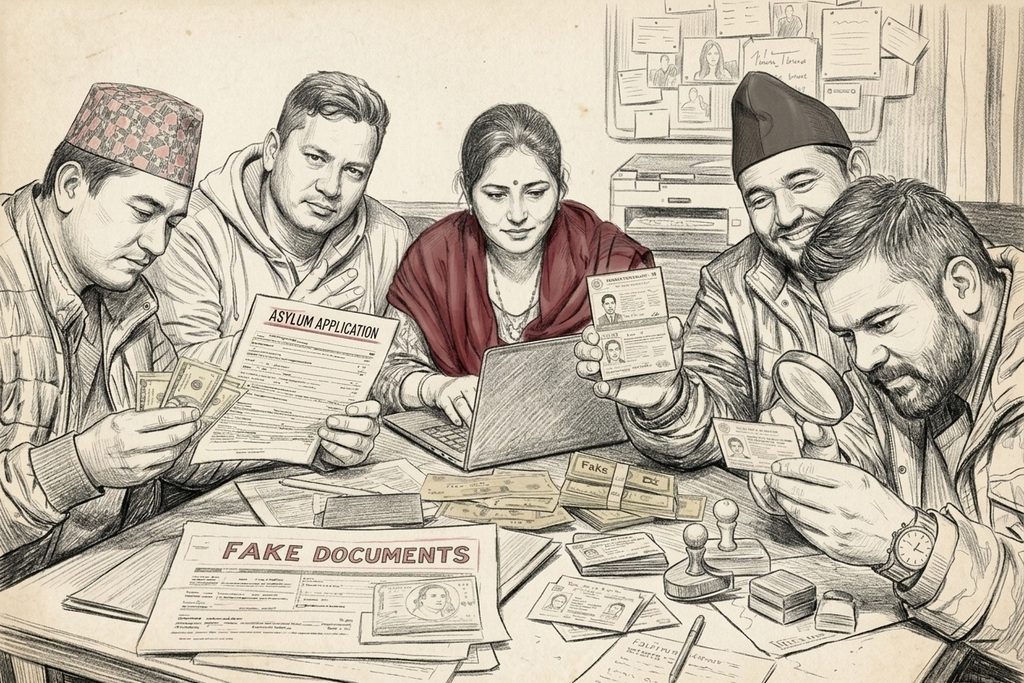
“Gangs that create fake documents for fraudulent asylum claims in France.”
Tactics used by these networks:
- Deleting or archiving Facebook and Instagram profiles before the asylum interview, removing evidence of a normal, non-persecuted life back home.
- Staying active on TikTok — a platform French asylum officers monitor far less — where some brokers openly live-stream ‘how-to’ guides for illegal entry.
- Purchasing fabricated documents in Nepal, including fake police reports, court filings, and political threat letters, through local brokers for cash.
- Running mock interviews to rehearse answers and eliminate inconsistencies before the real OFPRA interview.
- Changing names and identities after entering Europe through a third country.

This is not amateur, opportunistic fraud — it is an organised system with multiple layers of facilitation, from the broker in Kathmandu preparing fake documents to the ‘guide’ in Paris rehearsing the applicant for their OFPRA interview.
France’s Labour Shortage: The Elephant in the Room
Here is the uncomfortable question French politicians rarely ask publicly: does France, on some level, benefit from this system continuing to function this way?
France, like most of Western Europe, faces acute labour shortages in construction, hospitality, agriculture, and healthcare. Asylum seekers are eventually permitted to work after several months, and many take on jobs — physically demanding, low-paid, irregular — that French citizens increasingly decline.
The French government has officially acknowledged this tension by publishing a ‘métiers en tension’ (shortage occupations) list, identifying sectors where foreign workers are actively needed. Meanwhile, the informal labour market has long absorbed asylum seekers regardless of their legal status.
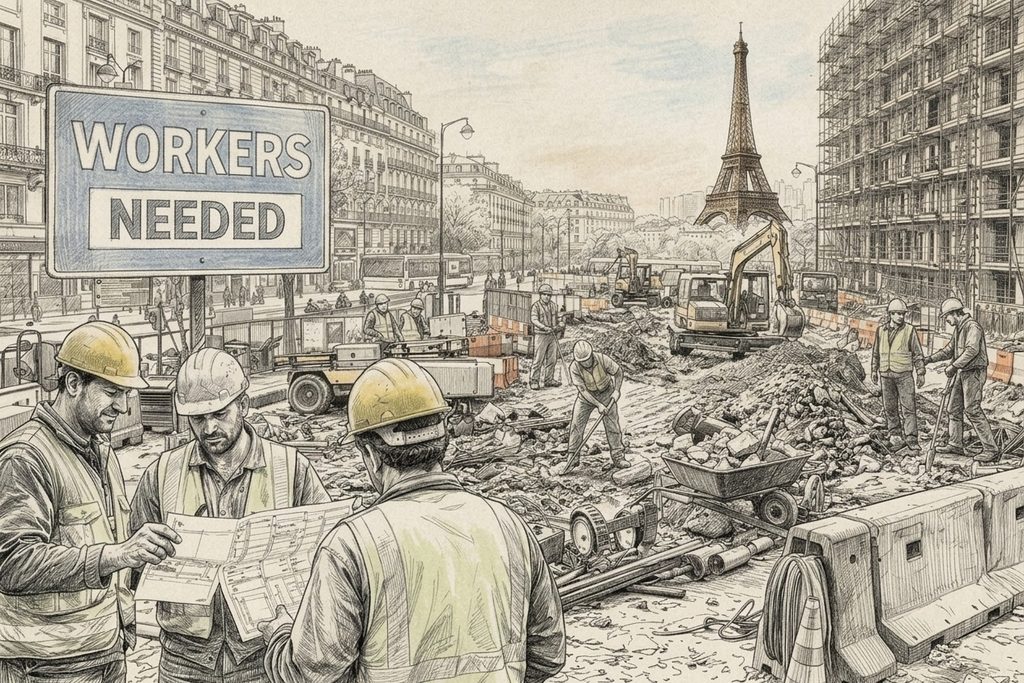
The question isn’t whether this dynamic exists — it demonstrably does. The real question is whether France’s slow, underfunded, overloaded asylum system is partly a feature rather than a bug: a mechanism that keeps cheap labour flowing while preserving the appearance of due process. As long as France needs that labour and lacks the political will to build a transparent worker-visa programme for countries like Nepal and Pakistan — as other European nations have done — the asylum system will remain a side door. And side doors, once discovered by organised networks, rarely close on their own.
Nepal’s Jailbreak Crisis: Criminals Seeking Asylum
The situation took a dangerous new turn in September 2025. Nepal’s ‘Generation Z’ protests triggered widespread civil unrest, and in the chaos, roughly 15,000 prisoners escaped from 28 correctional facilities nationwide — the largest prison break in South Asian history.
By March 2026, more than 5,000 of those escapees — many convicted of murder, kidnapping, and organised crime — remained unaccounted for. A significant number are believed to have fled the country through existing smuggling routes and broker networks.
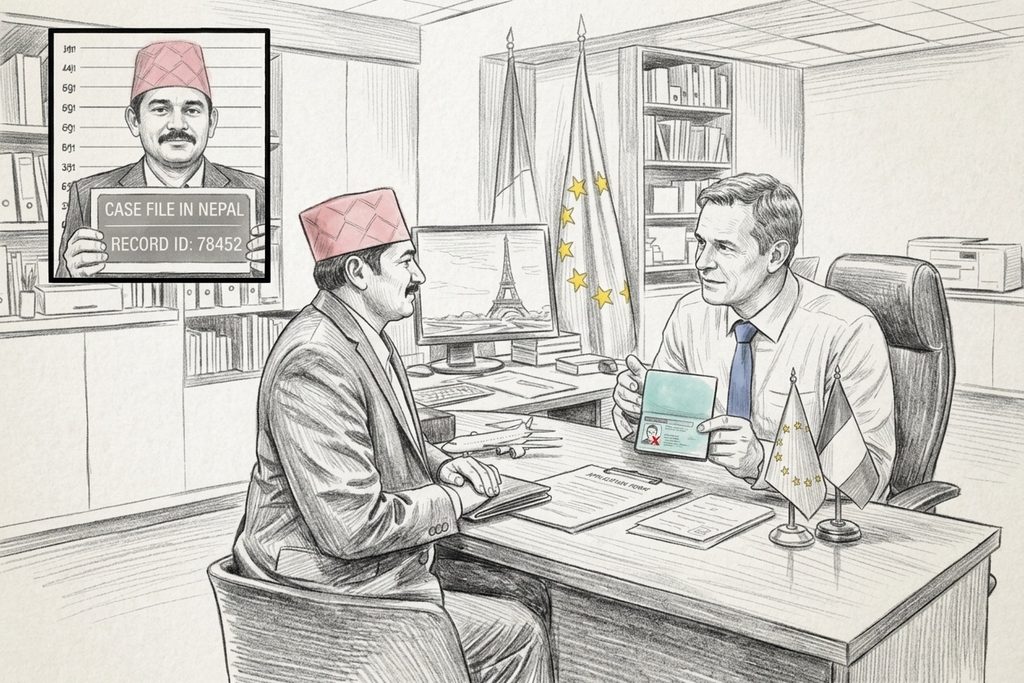
“Criminals from Nepal seeking asylum in France.”
Europe, and France specifically, is a known destination. The asylum system’s requirement for individual assessment, combined with its limited ability to verify criminal histories across jurisdictions, makes it an obvious point of entry. France cannot easily distinguish a genuine political refugee from a convicted murderer who has deleted his Facebook account and memorised a rehearsed story — this is not a hypothetical risk, it is a present one.
Meanwhile, genuine refugees from Syria, Ukraine, Afghanistan, South Sudan, Myanmar, and Iran — people who have fled real wars, ethnic cleansing, and political imprisonment — are forced to compete for a system increasingly clogged with fraudulent claims. The moral cost of this is enormous.
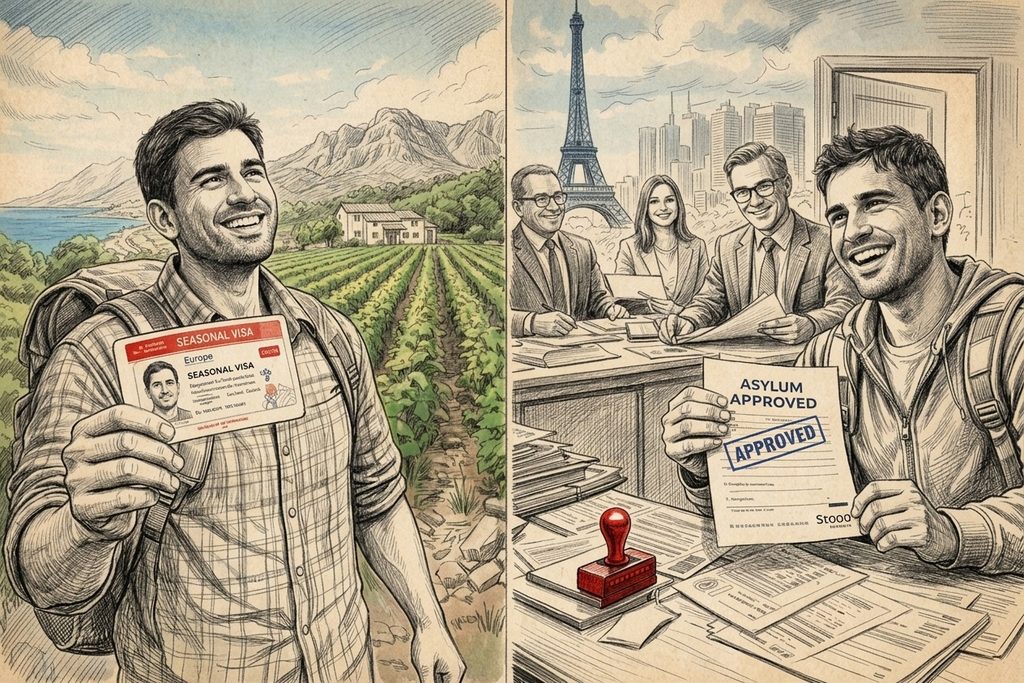
“Individuals entering Europe on seasonal visas from other European countries and then having their asylum approved in France.”
The Dublin Regulation: Designed to Fail
In theory, the Dublin Regulation — a cornerstone of EU asylum law — requires asylum seekers to apply in the first EU country they enter. In practice, this rule is riddled with holes, and France has repeatedly allowed applicants into its own system despite their having entered through other European countries first.
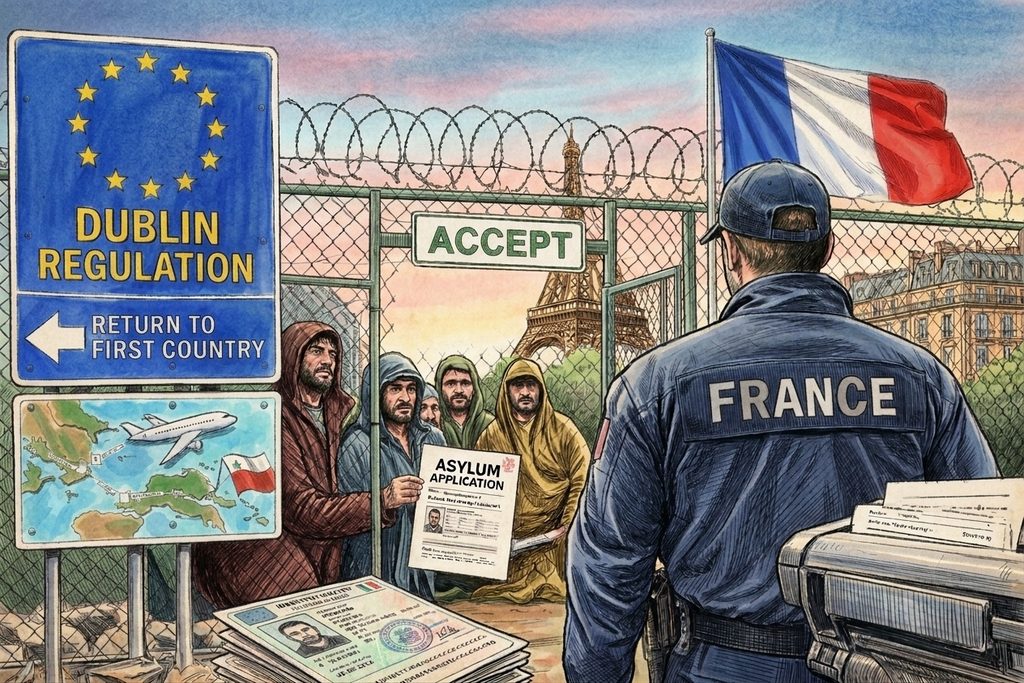
“Even though they entered through other European countries, France ignored the Dublin Regulation and allowed them into its own system.”
How the system breaks down:
- Applicants enter Europe on seasonal work visas — say, a harvest visa to Spain or Portugal — then travel overland to France, change identity, and apply as though arriving fresh.
- If fingerprints were not taken at the first country of entry, which is common with irregular crossings, France cannot identify them as a Dublin transfer candidate.
- Real-time information sharing between EU member states is far from seamless, and criminal records from origin countries are even harder to obtain.
- Some individuals appear to arrive without any traceable flight record, having entered France by road from a neighbouring country and bypassed passport control.
France’s own records are, in some cases, incomplete — there are documented instances of individuals receiving asylum in France despite having entered through another EU member state, simply because verification never happened. This gap is not a secret. Brokers know it, and they charge money to help clients exploit it.
Long-Term Consequences for France and for Nepal
For France:
- Security risk: Individuals with serious criminal backgrounds, undetected by French authorities, may establish criminal networks or engage in violent crime — an unidentified murderer absorbed into French society is, as one analyst put it, ‘a time bomb.’
- Erosion of social trust: As fraudulent claims consume resources, legitimate refugees wait longer, backlogs grow, and public hostility toward all immigrants — including genuine refugees — intensifies.
- Rule-of-law damage: When people with criminal histories receive state benefits and protection while evading justice, it corrodes public confidence in legal institutions.
For Nepal:
- International reputation damage: Nepal — a stable democracy, not a war zone — is increasingly associated in European policy circles with asylum fraud, affecting how Nepali nationals are treated at borders across Europe.
- Delayed processing for genuine applicants: A Nepali journalist or activist with a legitimate claim faces heightened suspicion simply because of the fraud surrounding the system.
- Moral and social cost: Nepal’s broker networks are feeding vulnerable young people into cycles of debt, exploitation, and legal limbo — years of uncertainty that are not a genuine path to prosperity.
Conclusion: Blindness, Convenience, or Complicity?
France’s asylum system is not broken by accident. It is the product of genuine legal obligations, administrative overload, and — perhaps — economic incentives nobody wants to name out loud. The result is a system that is theoretically rigorous and practically porous.
The organised Nepali networks exploiting this system are not exceptional; they are simply well-adapted to the incentives on offer. Fix those incentives — close the verification gap, fund OFPRA adequately, and build real-time data-sharing agreements with origin countries — and the networks lose their advantage.
The real losers in this story are the genuine refugees — people fleeing actual persecution — who wait longer, face more suspicion, and share a system with people gaming it for economic gain. They deserve better. And so does France.
Note: Images used in the original article are AI-generated for illustrative purposes only.
HASHTAGS:
#FakeAsylum #FakeRefugee #StopFakeAsylum #ReportFakeAsylum #AsylumFraud #ProtectRealRefugees #EndMassMigration #OQTF #FauxRefugiés #FauxAsile #AsileBidon #FraudeAsile #LoiImmigration #ImmigrationFrance #RefugieEconomique #IllegalImmigration #BorderControl #Deportation #EUWakeUp #NepaliFakeAsylum #NepaliInFrance #NepalFrance #NepaliDiaspora #DeportedNepali #NepaliInEurope #HumanTrafficking #NepaliDiaspora #AsylumFraud #IllegalMigration #DunkiRoute #NepalToEurope #MigrantExploitation #ForgedDocuments #FranceAsylum #HumanSmuggling #InvestigativeJournalism #NepaliNews #EuropeMigration #RefugeeSystem 🇳🇵 🇫🇷