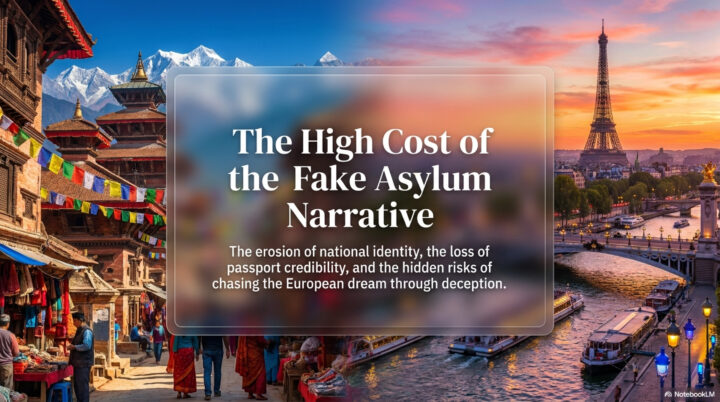
From Safe Country to Suspicious Passport: The Impact of Asylum Fraud on Nepal
Is it the pursuit of opportunity — or the betrayal of the motherland? A deep look at rising false asylum claims by Nepali nationals in Europe and their lasting consequences for Nepal’s passport, diplomacy, and genuine refugees.
The Borrowed Exile: When Hope Turns Into a Lie
There is a particular kind of silence that settles over a Nepali family the night before someone leaves for Europe. It is not pure grief. It carries the weight of hope and the shadow of sacrifice. In the eyes of the family, the young man or woman departing carries the future on their back.
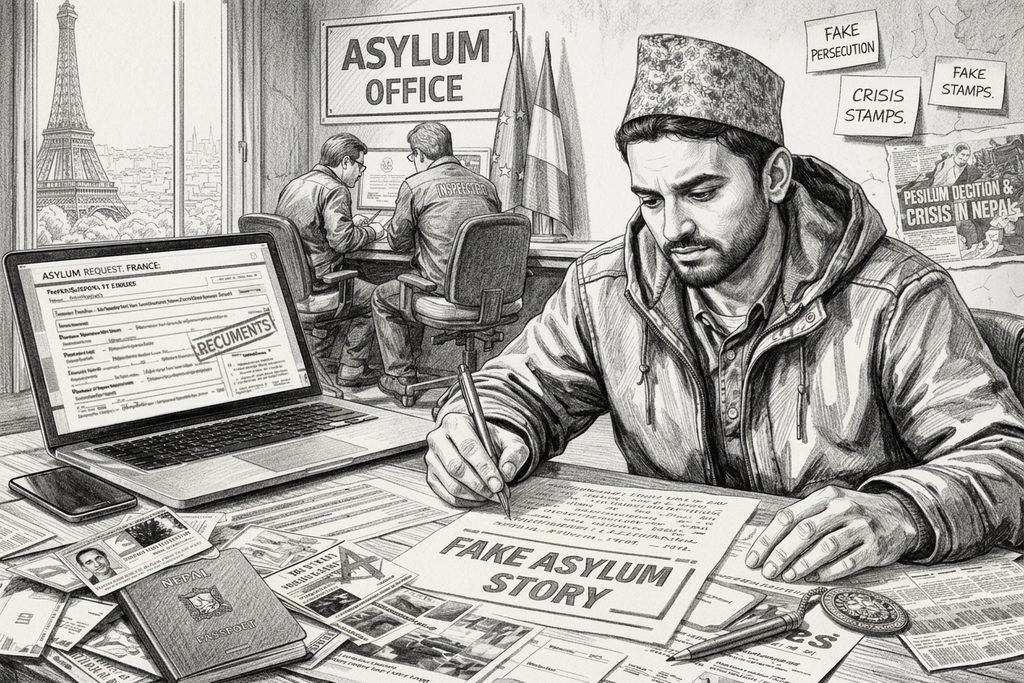
But what happens when that future is built on a lie?
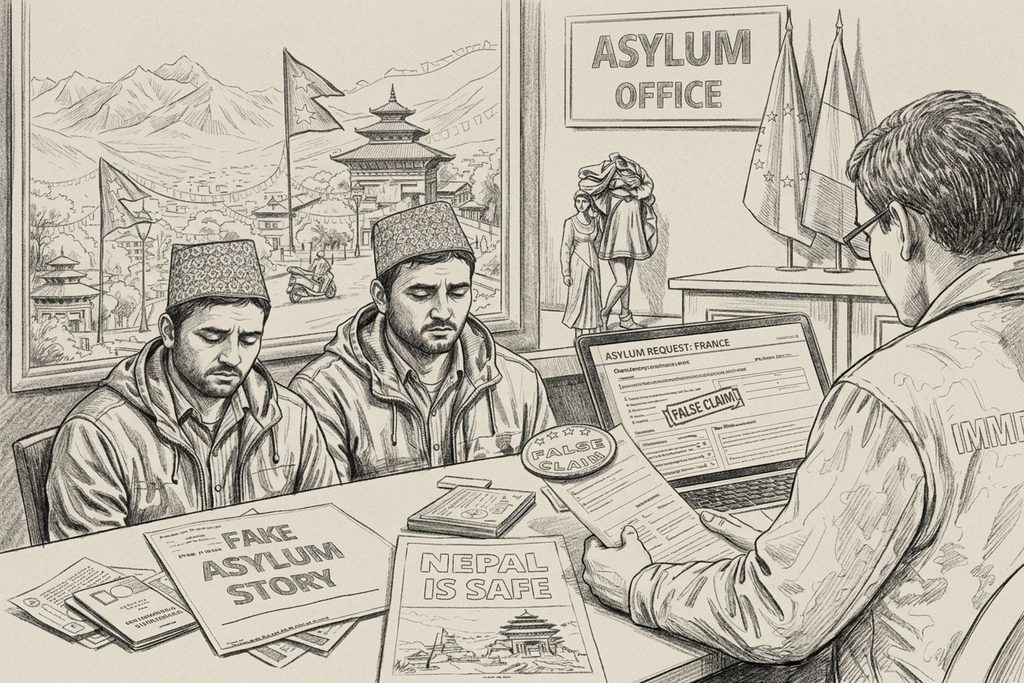
Across Europe today, a quiet and troubling pattern has emerged among parts of the Nepali diaspora. A growing number of individuals — many educated, many not fleeing any real danger — are filing false asylum claims under fabricated pretenses. They paint Nepal as a land of persecution, recycle old conflict documents, borrow refugee identities, and exploit a humanitarian system designed for the world’s most vulnerable people.
This is not a story about pure desperation. It is a story about choice — and the heavy consequences that follow.
Nepal Is Not a War Zone — And Everyone Knows It
Let us start with an uncomfortable truth: Nepal, despite political turbulence and economic challenges, is not a country at war. Citizens move freely. They speak freely. They protest, publish, vote, and complain loudly on social media without being dragged from their homes.
Several European countries have formally designated Nepal as a “Safe Country of Origin” — a legal classification that recognizes the general absence of systematic persecution. The decade-long Maoist conflict ended in 2006. Nearly two decades later, the guns are silent even if some wounds remain.
Yet asylum applications from Nepali nationals in Europe continue to rise. In France, Germany, Belgium, and the UK, immigration courts regularly encounter Nepali applicants claiming that returning home would cost them their lives. Some claims are genuine. According to legal advocates and immigration officials who handle these cases, the vast majority are not.
The unspoken question remains: why?
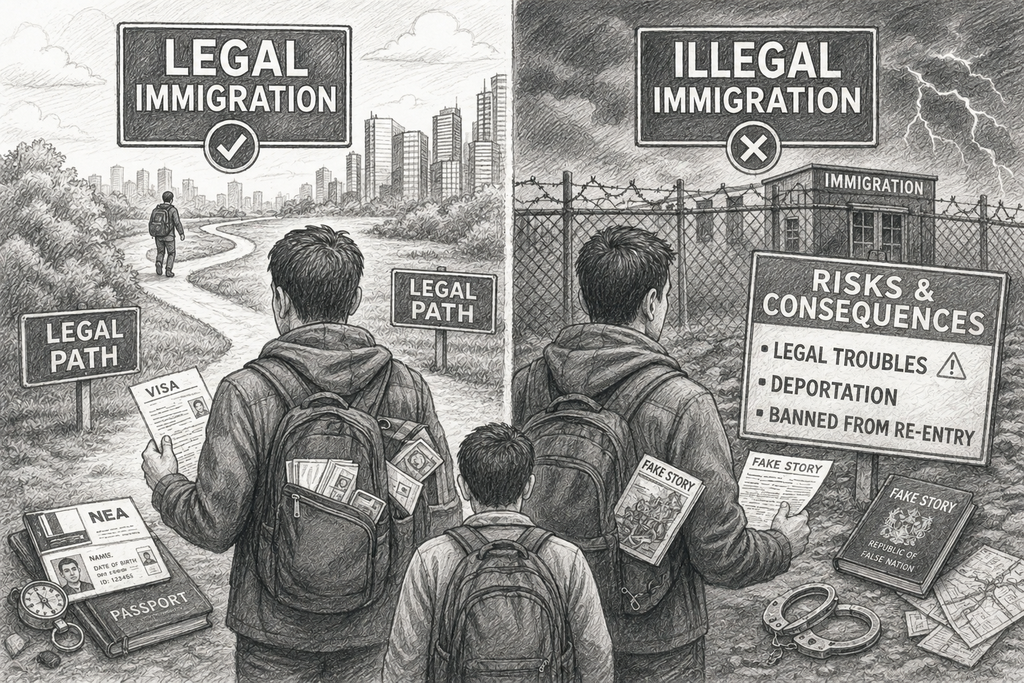
The Architecture of a Fabricated Asylum Claim
The methods behind false asylum claims by Nepalis in Europe are disturbingly sophisticated. These patterns have been observed across immigration offices, diaspora communities, and legal aid organizations.
Recycling Old Conflict Documents
Nepal’s civil war ended in 2006, but its paperwork — testimonies, police reports, displacement records — lives on. Applicants or the brokers coaching them take historical documents and present them as evidence of current danger. An elderly conflict-era incident becomes a present-day death threat. A disappeared family member from 2004 becomes “proof” of ongoing persecution in 2024 or 2025.
Identity Theft and Borrowed Refugee Stories
Some applicants present themselves as Bhutanese refugees or Tibetan exiles — groups with genuine, well-documented histories of persecution. Immigration officials across Europe report Nepali nationals who have memorized scripts about refugee camps in Jhapa or exile communities in Dharamsala — places they may have passed through or simply researched online.
The consequences of this identity theft are threefold:
- It dishonors communities that have endured real suffering.
- It taints every future Nepali application with suspicion.
- It erodes the credibility of Nepal’s passport on the world stage.
Personal Fabrications and the Broker Industry
Then come the personal fabrications: fake police reports of threats that never happened, invented political enemies, and manufactured persecution stories. These narratives are often assembled by brokers who charge high fees for ready-made storytelling packages. Some applicants arrive in Europe with their entire false narrative pre-packaged.
The Patriot Who Called Home Unsafe
Perhaps the most surreal part of this story is what happens after a false claim succeeds.
Across Europe, Nepali community organizations — cultural associations, football clubs, political diaspora groups — are frequently led by individuals who, not long ago, testified under oath that returning to Nepal would put their lives at risk. They received refugee status. They built legal residency on that claim.
And then they flew home to visit family during Dashain. They built houses in Kathmandu. They opened businesses. They attended political rallies. They posed for photographs outside Pashupatinath and posted them on Facebook — the same Facebook profiles that their asylum attorneys once argued proved the danger they faced.
These same individuals now position themselves as community leaders, nationalists, and philanthropists. They wave the Nepali flag at cultural events and make speeches about loving their country. The cognitive dissonance would be almost comedic if its effects were not so destructive.
What they have done is this: they told a foreign government that their own country was a place of oppression and violence — not because it was true, but because it was useful. In doing so, they made life measurably harder for every Nepali who comes after them.
Why False Asylum Claims Happen: The Real Pressures
To understand this phenomenon, we must resist the temptation to reduce it to simple moral failure. The pressures driving false asylum claims are real, even when the claims themselves are not.
The Visa Trap
A Nepali student or tourist who arrives in Europe on a temporary visa faces an almost impenetrable wall when trying to transition to a work permit. Legal pathways are narrow, expensive, and slow. As the visa expiry approaches and the thought of returning to economic uncertainty becomes unbearable, asylum becomes the only open door — not because of persecution, but because the system offers few other options for those who wish to stay.
The Weight of Social Shame
In Nepali culture, returning empty-handed from abroad carries enormous stigma. The family borrowed money for the flight. The neighbors know. The extended family is watching. “He came back with nothing” is a sentence that can follow a person for years. Asylum, even when fraudulent, offers a way to avoid that sentence — to stay, earn, send money home, and save face.
The Allure of the Safety Net
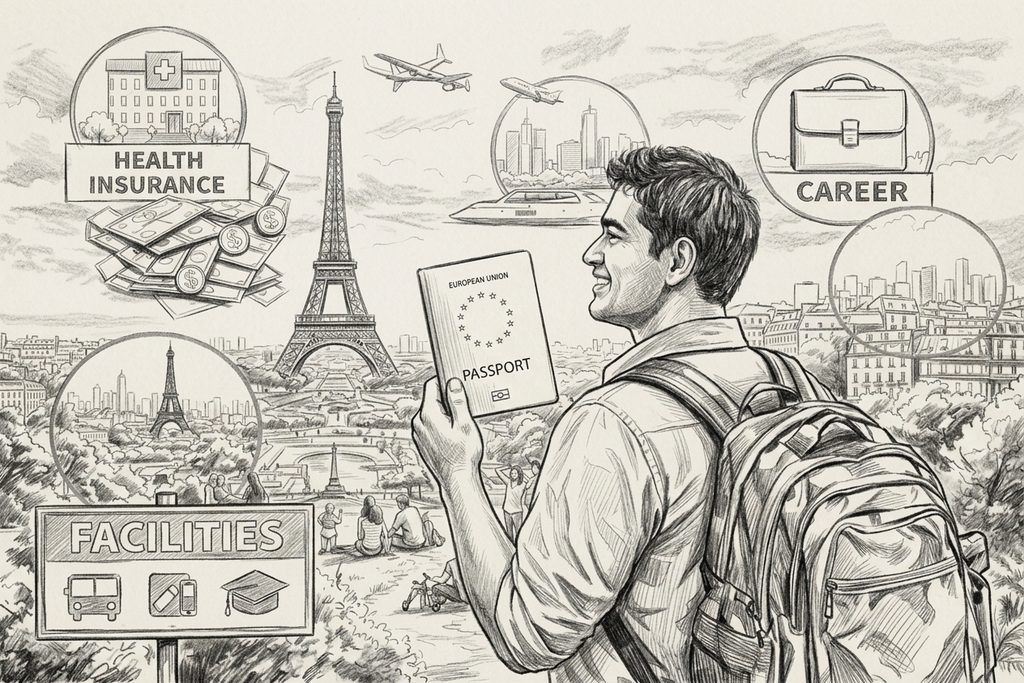
In countries like France, asylum seekers receive housing assistance, a monthly stipend, and access to healthcare. For someone who grew up without these securities, the appeal is powerful. When brokers describe these benefits in vivid detail, the temptation can feel overwhelming, particularly for young people who have never known a functioning social safety net.
The Broker’s Seduction
Migration brokers have refined their pitch. “File asylum and you’ll have papers in two years.” “Everyone does it. It’s easy.” Young people hand over life savings — often borrowed — and find themselves deep in a legal labyrinth they were never warned about. The brokers, naturally, are long gone.
Family Reunification as the Ultimate Goal
Once refugee status is granted, European law allows the holder to bring immediate family. For many applicants, this is the real prize — not personal safety, but a legal mechanism to relocate spouse and children to a wealthy country with functioning schools and hospitals. The asylum claim is the vehicle. Family reunification is the destination.
The Fake Documentation Industry
Nepal has developed a troubling cottage industry around fabricated asylum documentation. False police reports, threatening letters on counterfeit official letterhead, and witness testimonies from people who witnessed nothing can be obtained for a price before the applicant even boards the plane.
Who Pays the Price? The Bill Everyone Else Settles
The costs of false asylum claims are not abstract. They are paid daily by people who have done nothing wrong.
Consider the following real-world impacts:
- Legitimate students and professionals: A Nepali student applying for a study visa in Brussels may be rejected because her profile — young, educated, economically mobile — now matches the profile of thousands of asylum fraudsters.
- Patients needing medical care: A Nepali patient who needs specialized treatment abroad may struggle to obtain a visa because his nationality triggers elevated scrutiny.
- Skilled workers: A Nepali engineer or nurse offered a job in Germany may lose the opportunity because work-permit processes have slowed due to anti-fraud measures targeting the Nepali passport.
- Genuine refugees: The domestic violence survivor, the journalist facing real death threats, or the person whose sexuality genuinely puts them at risk now faces a presumption of fraud before their claim is even read.
Beyond individuals, Nepal’s diplomatic relationships with European nations have been quietly strained. Bilateral conversations that could focus on trade, development aid, or educational exchange are increasingly colored by immigration friction. A country that could be advocating for its citizens instead spends diplomatic capital defending itself against the perception that it exports fraudulent refugees.
For skilled workers — the engineers, nurses, and IT professionals Nepal produces in significant numbers — the international labor market increasingly views the Nepali passport with suspicion. Not as a symbol of a hard-working diaspora, but as a potential red flag for irregularity.
The Personal Cost: Living Inside a Lie
There is also a private cost that does not appear in immigration statistics or diplomatic cables.
The person who builds a European life on fabricated persecution lives in a particular kind of psychological captivity. Every knock on the door carries a charge of fear. Every official letter is opened with a quickened heartbeat. They cannot speak freely in community spaces because the story told to a judge years ago must be maintained forever.
They cannot fully belong to the country they have adopted, because belonging requires honesty. And they cannot fully return to the country they have abandoned, because the claim they filed described it as a place that would destroy them.
They are, in a profound and self-inflicted way, stateless — not by persecution, but by choice.
And the legal jeopardy never expires. European immigration law has a long memory. A residency granted on false grounds can be revoked years, even decades, later. Deportation remains a permanent possibility. The anxiety of discovery does not diminish with time; it compounds.
Conclusion: The Ground Beneath the Lie
Nepal is a country of extraordinary resilience. It has survived earthquakes and civil war, political chaos and economic stagnation. Its people have scattered across the globe — to the Gulf, to Southeast Asia, to Europe and North America — carrying a reputation for hard work, warmth, and tenacity.
That reputation is being quietly sold, piece by piece, in exchange for European residence permits.
The asylum system — built in the aftermath of World War II to protect the world’s most vulnerable — is not infinite in its capacity for goodwill. Every fraudulent claim makes it harder to process genuine ones. Every false story told in a European immigration office is a story told against Nepal itself.
The individual who files a false claim may gain years in Europe. But the country they misrepresented pays the interest on that debt indefinitely — in blocked visas, strained diplomacy, and the slow erosion of the trust that future generations of Nepalis will need to build their own legitimate paths abroad.
A house built on a lie is still standing. Until it isn’t.
HASHTAGS
#NepalInEurope #MigrationBrokers #FamilyReunification #LegalMigration #GenuineRefugees #NepalForeignPolicy #DiasporaIssues #VisaTrap #SocialShameAbroad #NepalYouthAbroad #EuropeanAsylumSystem #ProtectGenuineRefugees #NepalSoftPower #HardworkingNepalis #StopAsylumFraud
This article is intended for educational and awareness purposes. It highlights systemic issues surrounding false asylum claims while acknowledging the real pressures faced by many Nepali migrants. Supporting legal migration pathways and protecting genuine refugees remains essential.